
The RBI has changed the way it approached supervision in the past. Having seen a couple of collapses in the NBFC sector and the near-collapse of a few banks, it is focusing on regular drills to prevent a fire from breaking out, explains Tamal Bandyopadhyay.

Apart from the emotional value attached to buying gold, the yellow metal offers protection against inflation, interest rate spikes, currency and geopolitical risks, says Anamika Pareek.

rediffGURU Samkit Maniar answers readers' personal income tax queries.

Gold prices advanced Rs 700 to reach a new lifetime high of Rs 91,950 per 10 grams in the national capital on Wednesday on the back of continued buying by jewellers ahead of wedding season, according to the All India Sarafa Association. Besides, increased tensions in the Middle East and concerns about the US economic slowdown have kept the demand for safe-haven assets intact.

The Reserve Bank of India (RBI) on Wednesday came out with comprehensive draft guidelines to harmonise and regulate gold loans across all financial entities, including putting a cap of 75 per cent on loan-to-value (LTV) ratio. The draft guidelines also aim to address concerns related to certain lending practices, provide clarity on specific aspects, and strengthen the conduct-related standards in the sector.
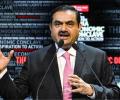
Moody's Ratings on Thursday said it will look at Adani group's governance practices when assessing the ports-to-energy conglomerate's ability to access capital in the aftermath of indictment of the group head Gautam Adani on bribery charges. "The indictment of Adani Group's chairman and other senior officials on bribery charges is credit negative for the group's companies," Moody's Ratings said in a statement.

Some major contracts coming up for renewal include TCS' deals with Star Alliance, a consortium of airlines based in Germany, and Nielsen; Infosys' deals with GE Appliances and Daimler; HCLTech's with UK-based life insurer Chesnara; Wipro's with German electric utility company E.ON and Petrobras of Brazil; and Tech Mahindra's with Circle Health.

While liquidity in the banking system has turned surplus in the last few weeks, it could go back to deficit again, mainly due to corporate advance tax outflows. The net liquidity surplus of the banking system rose to touch Rs 1 trillion on Tuesday on the back of government spending, according to the data released by the Reserve Bank of India.

A lower risk appetite among investors has driven gold, traditionally a safe-haven asset, to record highs so far this year. Fuelled by geopolitical tensions in West Asia, robust demand from central banks - particularly in Asia - and US President Donald Trump's tariff volleys, spot gold touched an all-time high of $2,956 per ounce on February 24 in the international markets.

Ambani and Adani account for a fifth of the net worth of all billionaire promoters in the country and half the combined net worth of the top 10.

From the Sensex pack, Adani Ports, Tata Steel, Power Grid, Mahindra & Mahindra, NTPC, Tech Mahindra, Tata Motors, ITC, Nestle India, HCL Technologies, Bharti Airtel, State Bank of India, Asian Paints and Kotak Mahindra Bank were the gainers. Bajaj Finance, IndusInd Bank, HDFC Bank, and Zomato were the laggards.

Credit-focused SIFs with lower minimum investment thresholds can provide a more practical option for investors with higher risk appetite, suggests Subodh Rai.

World Champion D Gukesh's quest for a victory continued as Hikaru Nakamura defeated him in the tie-breaker of the 5-8 place play-off at the Freestyle Chess Grand Slam.

The expectations of a borrowing cut by the government faded among bond-market participants after the general election results because they feel the compulsions of running a coalition may put pressure on the exchequer, according to dealers. The recent trend of moderate depreciation in the rupee's nominal effective exchange rate (NEER) might not persist if there are significant changes to the structural reform agenda.

All sectoral indices ended lower. BSE Telecommunication tanked 2.18 per cent, metal (1.77 per cent), auto (1.70 per cent), energy (1.64 per cent), oil & gas (1.59 per cent), commodities (1.39 per cent) and financial services (1.37 per cent) were the major laggards.

Gold prices could hit the $3500 an ounce (oz) mark in the next 18 months - up around 13 per cent from the current levels - given the global uncertainties and aided by investment demand, said analysts at BofA Securities in a recent note. Uncertainty around Trump Administration trade policies, BofA said, could continue to push the US dollar (USD) lower, further supporting gold prices near-term.
Equity benchmark indices Sensex and Nifty ended lower on Friday, dragged by auto stocks and relentless foreign fund outflows. Weak US markets and tariff threats also dented investor sentiment. The 30-share BSE benchmark Sensex dropped 424.90 points or 0.56 per cent to settle at 75,311.06.
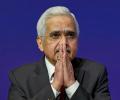
The highlights of RBI's bi-monthly monetary policy announced by Governor Shaktikanta Das:

Among the Sensex firms, State Bank of India rose the most by 3.78 per cent after the bank announced the acquisition of SBI CAPS subsidiary for Rs 708.07 crore. Nestle India gained 1.68 per cent after it reported around 9 per cent growth in sales. JSW Steel, Bajaj Finance, Axis Bank and Asian Paints were among the gainers.

The second-quarter performance of the top five information-technology services firms gives the hint that slow growth has bottomed out on the back of discretionary spending kicking in for the sector's largest vertical - the banking and financial services. However, concern about the macro-environment continues to be a challenge. Among the top four - Tata Consultancy Services (TCS), Infosys, HCLTech, and Wipro - it is Bengaluru-based Infosys that has performed the best and that was evident in its full-year revenue guidance.

Anmol Singh Jaggi and Puneet Singh Jaggi, once hailed as rising stars in India's clean energy sector, are now facing serious regulatory action.

The ideal time to invest in sector funds, is during a downturn so that investors can capitalise on a turnaround in 1.5 to 2 years.

About 300 fintech firms are under investigation by the ED for allegedly partnering 38 non-banking financial companies for predatory lending practices to charge borrowers high interest rates.
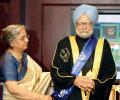
Nitin Desai, who has known Dr Singh from 1971, extends his 'deepest condolences to his wife Gurcharan Kaur and to his three talented daughters Upinder, the historian; Daman, the writer; and Amrit, the human rights activist.'
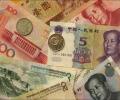
China on Monday assured the United States to reform its currency exchange regime but gave no timetable to address the key irritant in their bilateral ties.

From the 30-share blue-chip pack, Adani Ports, UltraTech Cement, Larsen & Toubro, Sun Pharma, HDFC Bank, ICICI Bank, NTPC and State Bank of India were the major laggards. Tata Consultancy Services, Reliance Industries, ITC, Asian Paints, HCL Tech and Maruti were among the gainers.

'Growth, liquidity and deposit mobilisation are likely to be discussed during the interaction.'

Engineering and construction major Larsen & Toubro (L&T) reported a 25 per cent rise in net profit attributable to the owners of the company for the January-March quarter of 2024-25, owing to higher revenues and an exceptional gain. For the quarter under review, L&T posted a consolidated net profit of Rs 5,497.3 crore, while revenue rose 10.9 per cent year-on-year (Y-o-Y) to Rs 74,392.28 crore.

From the Sensex pack, Tata Consultancy Services and Infosys fell over 2 per cent each. Hindustan Unilever, Bharti Airtel, Sun Pharma, Power Grid, Bajaj Finserv, HCL Tech, Mahindra & Mahindra, and Tech Mahindra were also among the laggards. Among the gainers, Zomato jumped nearly 5 per cent. Larsen & Toubro, Axis Bank, ICICI Bank, IndusInd Bank and Kotak Mahindra Bank were also among the gainers.

From the 30-share blue-chip pack, Zomato cracked nearly 7 per cent. Power Grid, Adani Ports, Tata Steel, NTPC, Tata Motors, Tech Mahindra, Mahindra & Mahindra, Asian Paints, Sun Pharma and UltraTech Cement were the other major laggards. In contrast, Axis Bank, Hindustan Unilever, Tata Consultancy Services and IndusInd Bank were the gainers.

Having recovered completely from an injury following a car accident, Mumbai's Musheer Khan is determined to make an impact in his maiden IPL season.

From the 30-share blue-chip pack, ITC Hotels, IndusInd Bank, Mahindra & Mahindra, Sun Pharma, UltraTech Cement and NTPC were among the biggest gainers. Titan, Kotak Mahindra Bank, Nestle, Asian Paints, HCL Tech and ICICI Bank were among the laggards.
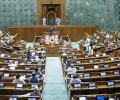
The deportation of Indians from the United States, deaths in the Maha Kumbh stampede and the joint Parliamentary committee report on the Waqf bill were among the issues that led to heated exchanges and some disruptions in an otherwise smooth first part of the Budget session that ended on Thursday.

S&P Global Ratings on Thursday said about half of the Indian companies that it rates are getting a boost in their core profitability from rupee depreciation. "Much of our rated India corporate portfolio has sizable US-dollar linked revenue and, therefore, is not exposed to rupee depreciation. "This encompasses entities in the IT, metals, and chemicals sectors. About half of the firms we rate are getting an EBITDA boost from currency weakening," the US-based rating agency said in a report.
From the 30-share Sensex blue-chip pack, Titan, Adani Ports, UltraTech Cement, Tata Consultancy Services, NTPC, Bharti Airtel, Tech Mahindra, Infosys, Hindustan Unilever and JSW Steel were the biggest laggards.
Defying the bearish sentiment in the markets on Monday, ICICI Bank's share price rose by 2 per cent, reaching an intraday high of Rs 1,234.4 per share on the BSE. With a 1.5 per cent gain at the close, the stock emerged as the top performer on both the BSE Sensex and the National Stock Exchange Nifty 50 indices.

'I have idolised him from a young age and he is a legend of the game.'

From 30 Sensex shares, Bajaj Finserv jumped nearly 8 per cent while Bajaj Finance soared over 6 per cent. Maruti, Titan, Mahindra, Mahindra & Mahindra, Infosys, HCL Tech, Zomato, UltraTech Cement and Kotak Mahindra Bank were the other major gainers. Sun Pharma emerged as the only laggard.

American President Donald Trump has announced imposing reciprocal tariffs on its major trading partners including China that levy higher import duties on goods shipped from the United States. He has already announced a 25 per cent duty on steel and aluminium imports, which will come into effect from March 12.

Under its new chairman Tuhin Kanta Pandey, the Securities and Exchange Board of India (Sebi) has gravitated towards greater transparency and ease of doing business, setting an objective of "effective and optimum" regulation. On Monday, during its first board meeting under Pandey, the regulator has decided to constitute a high-level committee (HLC) to review conflicts of interest and unveiled initiatives to simplify regulatory processes.
